Tax resolution software
Your best work shouldn’t depend on which employee opens the case.
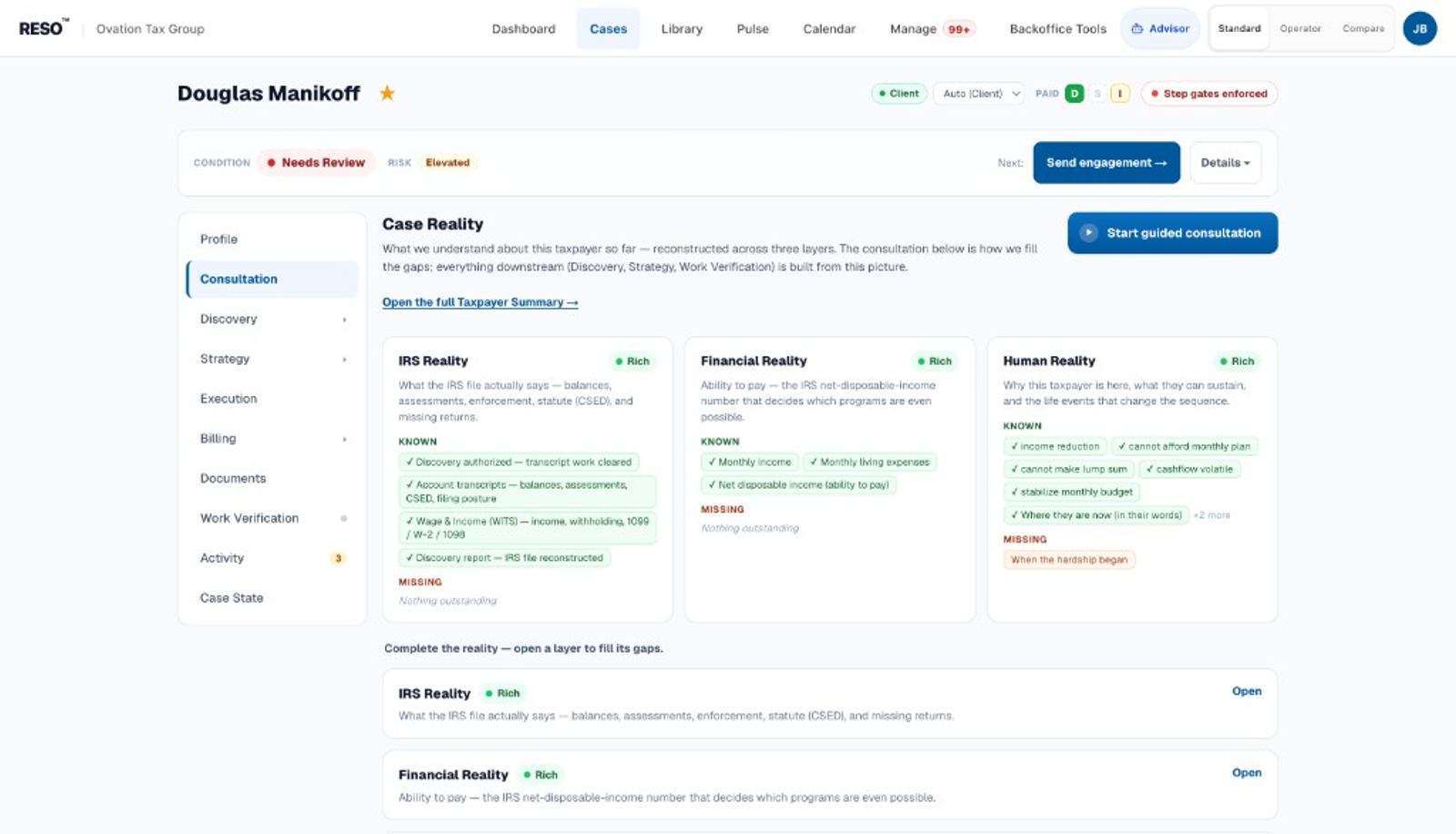
One case record runs the whole engagement — Discovery and Strategy you sell upfront or close with, work plans and deadlines projected from the IRS ledger itself, and a verification record that defends every fee.
$249/month platform · $10 Discovery · $25 Strategy · $10 Work Verification · $0.75 e-sign. First 30 days: card required when you subscribe, usage tracked, $0 due on your first usage invoice. Platform fee starts on day 31 via your subscription.
Including the work product you’d hand the client.
Recognition
There is a better way.
Replace this
With this
RESO.tax
RESO.tax is the operating system that runs a tax resolution firm — from the first client conversation to the final defensible work product and retention record.
The hidden cost of reinvention
Every operator reinvents the case
Every new employee reinvents the process
Every deliverable gets rebuilt
Strategy depends on who’s working that day
Philosophy
RESO.tax helps tax resolution firms turn expertise into repeatable methodology, preserve it inside every case, and deliver the same high standard of work no matter who is handling the engagement.
Your clients deserve your firm’s methodology, not your employees’ memory.
Your firm remembers every case.
And every completed case makes your firm better.
Your firm should improve every time you finish a case, not start over every time you open one.
Economics
Full-stack case intelligence on one matter — Discovery, Strategy, and Work Verification — typically $45.
Platform economics
$249/month · unlimited users & cases
Intelligence credits when you run analysis: $10 Discovery · $25 Strategy · $10 Work Verification · $0.75 e-sign. Full-stack case intelligence typically $45 per matter. First 30 days: card required when you subscribe, usage tracked, $0 due on your first usage invoice. Platform fee starts on day 31 via your subscription.
A second business model
Most firms give the analysis away to win the engagement. RESO turns the entire advisory phase into products: Discovery Intelligence, then Resolution Strategy — two paid, defensible deliverables your firm sells and retains before any implementation agreement is signed. And if your firm doesn’t sell exploratories, the same Discovery works the other way: strong enough to close Strategy and implementation on findings instead of promises, and to stand later as the record of value delivered.
Bill the diagnosis. Discovery is a deliverable, not a sales expense.
Bill the plan. Resolution Strategy is the second paid deliverable — sold and retained before implementation begins.
Don’t sell exploratories? Run the same Discovery uncharged — it closes implementation on findings and defends the value after.
Quote implementation from evidence — the IRS file, not the client’s memory.
The arithmetic
Firms on RESO sell Discovery at $350–$1,500, then Resolution Strategy at $1,500–$5,000 — up to $6,500 of advisory revenue per case, collected before implementation is even quoted.
Producing both deliverables costs your firm a fraction of the fee in metered intelligence credits. The advisory phase stops being a sales expense and becomes the margin engine — and the client who paid for the plan retains the firm that wrote it. Firms that don’t bill the exploratory run the same play uncharged: Discovery closes the implementation engagement, then defends its value after the work is done.
Generated by the live RESO pipeline from a fully fictional case — names, balances, and identifiers are synthetic.
After the close
The day the engagement is sold, one click seeds the resolution program as a dated work plan. Every deadline lands on the firm calendar — including CSEDs and CDP windows projected from the transcript itself — staff get a daily digest, and managers see a stalled case before the client feels it.
Every case has an owner. Every case has a next step. Every case has a deadline. Every case has proof.
An owner
Sales and resolution staff are assigned the moment they touch the case — no unowned matters.
A next step
The day the engagement is sold, the program playbook seeds a dated work plan — nobody invents the task list.
A deadline
Due dates land on the firm calendar — including CSEDs and response windows projected from the IRS ledger.
Proof
Every step is attested — actor, timestamp, evidence — and confirmed against the transcript on refresh.
Every other practice system runs on what your staff remember to type. RESO runs on what the IRS ledger says.
Built-in program playbooks — OIC, installment agreements, CNC, penalty abatement, CDP — seeded as dated steps with one click
Deadlines projected from the parsed IRS ledger: CSEDs, CDP response windows, notice dates — labeled as estimates, sourced from evidence
Steps are attested, not checked off — actor, timestamp, and evidence reference on every step
One firm calendar you can subscribe to from Google or Outlook, a daily digest of due and overdue work, and manager escalation when a program stalls for a week
And the transcript confirms the work: TC 480/780 offer postings, installment agreement entries, TC 530 currently-not-collectible, and penalty reversals verify the claimed status on every refresh — then feed the fee defense.
Execution monitoring
RESO derives a health state for every matter from the signals already on the record — owner, work plan, deadlines, activity. Not a score: a labeled state that names its reasons, so a manager acts on evidence instead of a number.
Health states roll up to a firm view — on track, needs attention, at risk, waiting on client — and to a per-owner workload view, with waiting-on-client kept separate so external silence never reads as internal stall.
Found money
Deterministic reconciliation runs on every case: withholding credits absent from the account, student-loan interest and foreign tax paid on information returns, refund-statute windows, penalty patterns, SFR posture, multi-year amendment sequencing. Your CRM stores what your people type. RESO reads the IRS evidence and flags what they didn’t.
A reconciliation finding as it appears on the case record — deterministic, not AI-generated.
Proof
RESO.tax is the operating system that runs a tax resolution firm — from the first client conversation to the final defensible work product and retention record.
Most tax resolution software stores cases. RESO produces the work — and the record that defends it. How we define tax resolution software · The methodology
Work product
IRS posture, urgency, program fit — advisory-grade diagnosis your firm can bill for.
Work product
Option ordering, sequencing, and implementation roadmap tied to the same case record.
Work product
Evidence of work performed — fee defense and retention when expectations shift.
Page 1 of the actual PDF — not a mockup.
Hold the deliverable before you believe the pitch.
Generated by the live RESO pipeline from a fully fictional case — names, balances, and identifiers are synthetic.
Get the sample Discovery reportEvery recommendation is backed by evidence. Every deliverable is preserved. Every case strengthens the next one.
Full engagement lifecycle
What actually happens in RESO
Ten steps on one governed case record — from first client contact through defensible work product and retention.
Fee defense
1 · The dispute
A client disputes the fee — chargeback, refund demand, or a complaint. Your current record is a folder of PDFs and a timeline rebuilt from memory.
2 · The record
You export the Work Verification record: what was done, when, by whom — each step tied to the IRS evidence on the case record.
3 · The outcome
The fee is defended with evidence of work performed, not a narrative written after the fact.
Who it’s for
Solo founder, boutique, established firm, or a tax business adding resolution — same methodology, same work product, different entry point.
Founders & new firms
Launch a resolution practice with two people — the methodology, work product, and commercial stack are already built.
Launch on RESO →Enrolled agents & boutiques
Repeatable methodology and client-ready work product — less rebuild, more defensible engagements.
For enrolled agents →Resolution firms
One standard on every case: sales, intake, and practitioners aligned on the same methodology.
For resolution firms →Tax preparers & CPAs
Turn prep clients with balances into billed Discovery consults — without reinventing the process each time.
Add resolution revenue →Established firms with a stack
Run RESO alongside your current CRM and standardize without a rip-and-replace — new cases first, legacy matters as they touch.
See the migration path →Partners & platforms
Tax prep chains, franchises, and software platforms adding resolution to their offering — co-branded work product under your brand.
Partner with RESO →Happy with your stack?
Canopy / TaxDome
Practice management stays where it is. RESO owns what they don’t do at all: the resolution work product and the IRS-evidence intelligence behind it.
HubSpot or a sales stack
Keep your pipeline and dialer. RESO starts where the deal closes — and arms your closers with Discovery and Strategy deliverables they can sell outright or use to close implementation on findings.
IRS Logics
The Case Bridge links matters across both systems. New cases standardize on RESO; legacy matters move when they next touch.
Homegrown CRM
You built it because nothing fit. RESO’s engines are deterministic and every figure traces to its evidence tier — inspect the demo case before you believe it.
See it on a complete case
Walk through Discovery, strategy, verification, and retention on one governed case record — not a generic product tour. Including the work product you’d hand the client.
$249/month platform · $10 Discovery · $25 Strategy · $10 Work Verification · $0.75 e-sign. First 30 days: card required when you subscribe, usage tracked, $0 due on your first usage invoice. Platform fee starts on day 31 via your subscription.